Container shipping faces a potential capacity surplus as a wave of vessel deliveries could coincide with shorter voyages through the Red Sea and Suez Canal, according to a commentary published by Splash 247. Dr Raymon Krishnan, president of Singapore’s Logistics & Supply Chain Management Society, argues that carriers must weigh new ships’ efficiency against the risk that markets will have changed by delivery.
Citing Drewry’s third-quarter 2026 Container Forecaster, the commentary puts the global containership orderbook at about 13.9m teu on 1 September 2026, representing 40.9% of the operating fleet. Drewry projects fleet expansion of 8.4% in 2027, 12.1% in 2028 and 9.4% in 2029. Those additions would arrive after congestion, equipment shortages and disrupted routes had previously absorbed shipping capacity.
Diversions via the Cape of Good Hope have kept vessels occupied for longer. A progressive restoration of Red Sea and Suez services could reverse that effect, making more capacity available even before new ships are delivered. The Splash 247 contribution suggests that, alongside newbuildings, this could leave vessel capacity as much as 10% above demand. Possible responses include cancelled sailings, slower operating speeds, ships being taken out of service and faster recycling of ageing tonnage.
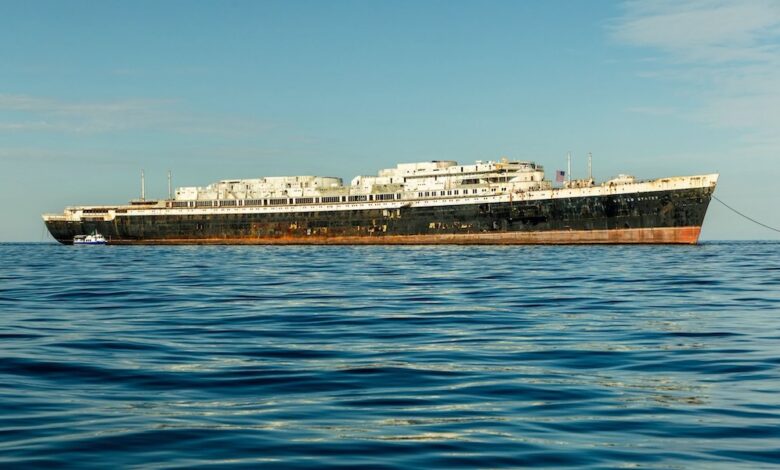
Krishnan frames the warning around the deliberate sinking of the SS United States off Destin, Florida, for use as an artificial reef. The liner entered service in 1952 and was withdrawn in 1969 as aviation reshaped transatlantic travel. Its experience illustrates how changing transport economics can undermine a technically accomplished vessel, although the commentary stresses that container shipping remains fundamental to trade and new ships are not inevitably redundant.
The consequences would extend beyond carriers. Moving smaller ships from mainline services into regional markets could increase competition, while ports could face altered berth needs, service patterns and transhipment flows. Cargo owners might benefit from cheaper freight but encounter less reliable frequencies and transit times if carriers combine services, cancel departures or revise port calls. Krishnan argues that fleet planning must account for the economic, environmental and operational effects of retiring existing vessels, with recycling remaining the main end-of-life route when further deployment is no longer commercially viable.