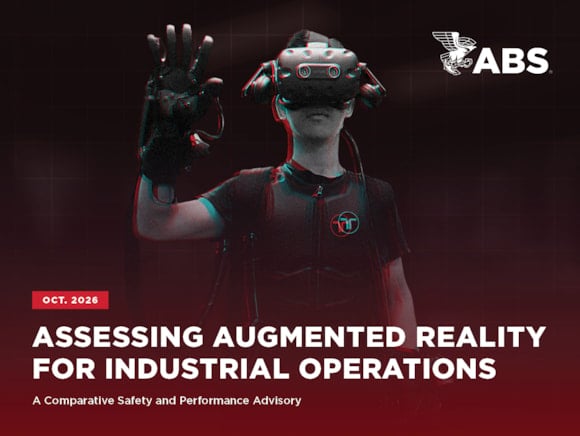
ABS has published guidance to help marine and offshore operators assess whether augmented reality can improve crew performance without weakening safety. According to an ABS announcement carried by The Maritime Executive, the advisory sets out an approach to testing the technology against existing working methods, rather than assuming that access to digital information will automatically make tasks safer or more efficient.
The publication, ABS Advisory on Assessing Augmented Reality for Industrial Operations, covers potential uses in inspection, maintenance, navigation, training and remote assistance. Its focus is on measuring how AR affects both safety and performance in the work crews actually undertake. ABS says wider adoption depends on establishing that productivity improvements can be delivered without compromising safe operations.
The technology can bring instructions and operational information into a worker’s field of vision. Applications described in the announcement include showing technicians the sequence of a procedure, identifying equipment inspection locations and tolerances, and highlighting hazardous or restricted areas as personnel move around. However, ABS cautions that the value of those functions varies with the individual user, the task being performed and the conditions in which the work takes place.
Developed with support from the ABS Laboratory for Ocean Innovation at Texas A&M University, the advisory provides a structured method for comparing AR-assisted work with baseline practices. It distinguishes between activities that depend on navigation, hand-eye coordination, recall or information processing, recognising that each places different demands on personnel. The assessment therefore needs to be tailored to the particular activity the application is intended to support.
The guidance also addresses potential drawbacks, including distraction, obstruction of the user’s view and excessive reliance on information supplied by the system. Patrick Ryan, ABS senior vice president and chief technology officer, said responsible adoption required a rigorous understanding of the implications for safety and performance. ABS said it would continue supporting industry as AR moves beyond trials into routine operations.