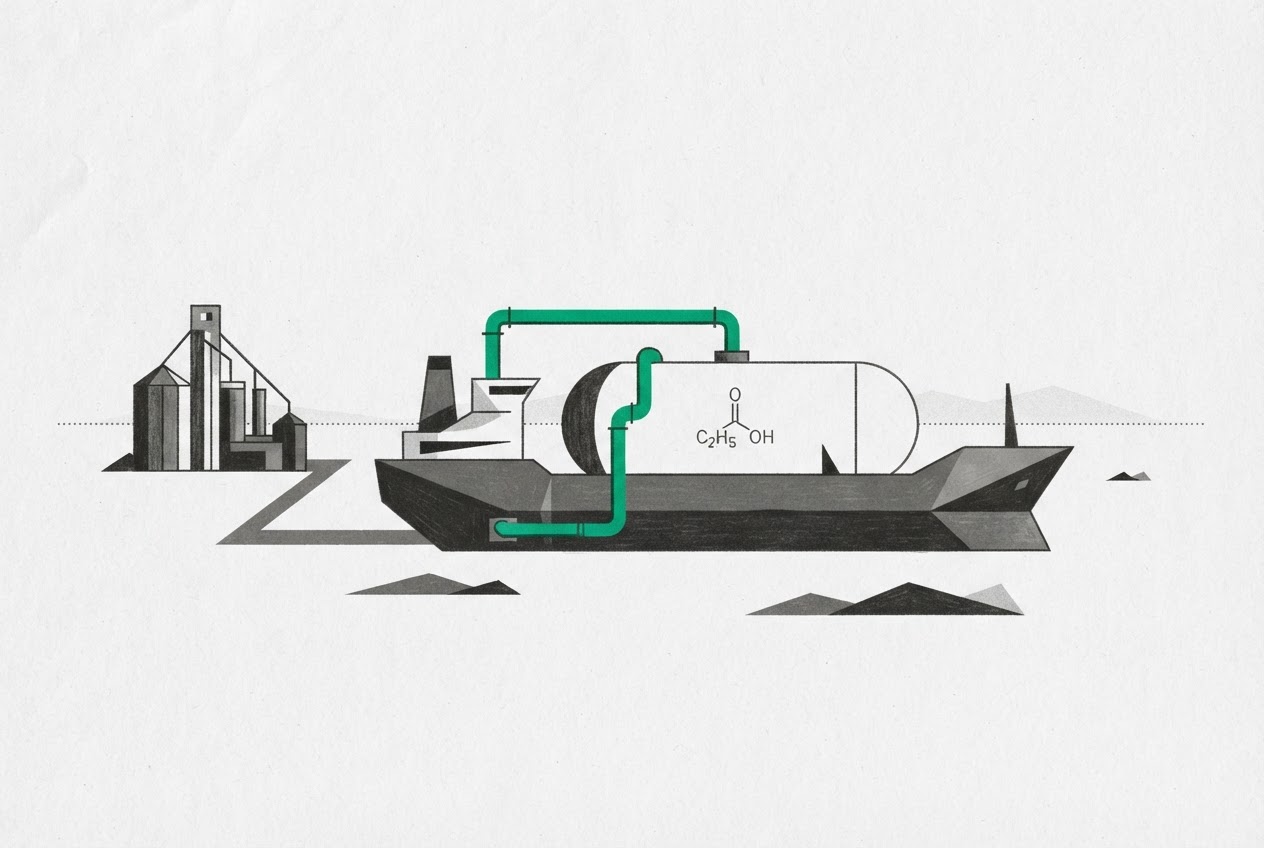
US ethanol producers could supply fuel to the growing methanol-capable shipping fleet using existing production and export infrastructure, according to a study reported by Hellenic Shipping News. The Maritime Ethanol & Methanol Alliance (MEMA) says ethanol can be used in methanol dual-fuel engines and bunkering systems with limited modifications, offering shipowners another option while supplies of low-emission methanol remain constrained.
The study, Marine Ethanol: Unlocking the US Opportunity, identifies more than 300 methanol-capable vessels operating or on order that could use ethanol alone or mixed with methanol. It puts annual US ethanol production capacity at 18.5 billion gallons, compared with output of 16.4 billion gallons in 2025, leaving roughly 2 billion gallons of unused capacity. The US accounts for slightly more than half of global fuel ethanol production and exports to about 80 countries, principally through Gulf Coast terminals that also serve as major bunkering centres.
International shipping consumes approximately 300 million tonnes of fuel annually, valued at an estimated US$180 billion, the study says. Its illustrative scenarios suggest that supplying 1% of that consumption by mass with ethanol would require about 1 billion gallons, within current spare US capacity. Raising the share to 5% by the mid-2030s would require around 5 billion gallons.
Commercial use is beginning to follow trials. On 28 September, Tangier Maersk received US corn ethanol through a commercial ship-to-ship bunkering operation in Houston. Hellenic Shipping News described it as the first publicly announced US ethanol bunkering of a deep-sea container vessel. The study rates ethanol at technology readiness level 8–9, indicating technical maturity with commercial deployment emerging.
Compared with heavy fuel oil, the study says ethanol almost eliminates sulphur oxide emissions, reduces nitrogen oxides by 40–94% depending on engine technology, and cuts particulate matter by 90–99%, without scrubbers. It estimates production costs below US$1 a gallon after co-product revenue. These are study findings, rather than a quoted delivered bunker price.
MEMA, a platform of the Global Centre for Green Fuels, published the study with technical analysis from ABS and industry input from US producer Marquis Energy; its recommendations are MEMA’s. Centre managing director Clarence Woo identified consistent marine fuel specifications, traceable feedstocks and reliable custody records as priorities for wider adoption. The report comes ahead of an expected International Maritime Organization decision on next steps for its Net-Zero Framework at an extraordinary session on 4 December.